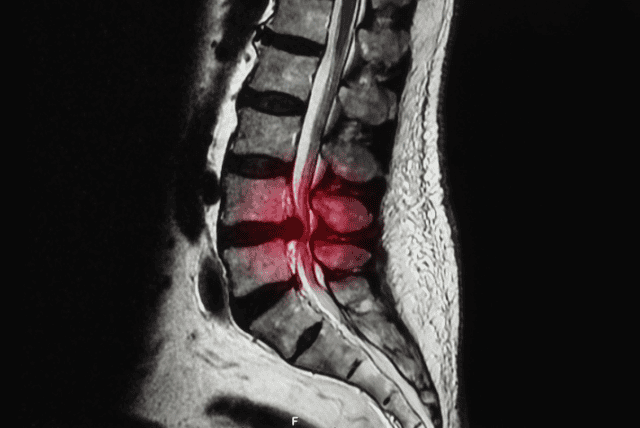
This guide walks through exactly that — what these terms really mean, what to do (and not do) in the days right after diagnosis, and how to build a genuine recovery plan rather than just waiting anxiously for things to get worse.
Disc Bulge, Slipped Disc, Herniated Disc — Are They the Same Thing?
Not quite — though the confusion is completely understandable, because these terms often get used loosely, even by well-meaning practitioners.
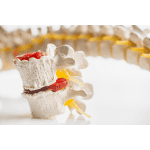
Disc bulge (or bulging disc):
the outer layer of the disc stays intact, but the disc itself extends slightly beyond its normal boundary — a bit like a tyre bulging under pressure without actually puncturing.
Slipped disc:
A common, older term for a herniated disc. Discs can’t actually “slip” out of place — they’re fixed between the vertebrae above and below — but the name has stuck around in everyday language.
Herniated disc:
The outer layer has torn, and some of the softer inner material has pushed through. This is a step beyond a simple bulge, and it’s more likely to irritate a nearby nerve. When that nerve is in the lower back, it can cause sciatica: pain that travels from the buttock down the leg.
If you’ve been told specifically that you have a herniated disc, our dedicated guide on herniated discs goes deeper into symptoms, causes, and whether surgery is genuinely necessary. This article focuses on the earlier end of that spectrum — disc bulges and the general “something showed up on my scan” situation.
What to Do in the First Few Days After Diagnosis
The days right after a diagnosis are when people are most likely to overcorrect in one direction or the other — either pushing through pain because they’re determined not to be limited by it, or becoming so cautious they stop moving almost entirely. Both tend to backfire.
A more useful approach in the first few days:
Stay gently active. Complete bed rest is rarely recommended anymore — some movement, even just short, easy walks, tends to support recovery better than lying still.
Avoid the specific movement that aggravated it, not all movement. If a particular bend or twist clearly triggers pain, avoid that specific motion for now — that’s different from avoiding activity altogether.
Don’t panic-book surgery consultations. Most disc bulges and even many herniations improve significantly with time and the right rehabilitation — surgery is rarely the immediate next step, and shouldn’t feel like the only option on the table.
The single most useful thing you can do early on is get a proper assessment — not just of the disc itself, but of the posture and movement patterns that likely contributed to it in the first place.
Told you have a disc problem?
What’s safe and what helps depends on how your body moves. A proper assessment shows what’s loading the disc, and builds a recovery plan around it.
Step 1 — Understand What Your Scan Actually Shows
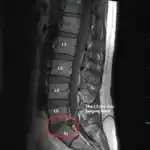
 This is the part that catches most people off guard: a disc bulge on a scan is extremely common — including in people who have no back pain at all.
A widely cited review of imaging studies found that disc bulges show up in roughly 30% of pain-free 20-year-olds, rising to around 84% of pain-free 80-year-olds (Brinjikji et al., 2015). In other words, a bulge showing up on your scan doesn’t automatically explain your pain — it may simply be a normal, age-related finding that would show up on plenty of pain-free spines too.
That’s not to say your pain isn’t real, or that the disc bulge is irrelevant — just that imaging alone doesn’t tell the whole story. What matters more is how your specific pain behaves, what movements ease or worsen it, and what your posture and muscular function look like day to day.
Step 2 — Address the Movement Pattern, Not Just the Disc
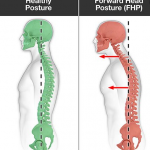
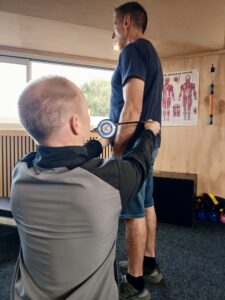 A disc bulge rarely appears in isolation. In our experience, it’s usually the end result of a movement pattern that’s been placing uneven, repeated pressure on the spine for months or years beforehand — the same postural loading and core dysfunction that drives most chronic back pain.
This is exactly the territory covered in The Real Cause of Lower Back Pain That Keeps Coming Back and it applies just as directly here. Treating the disc without addressing the underlying pattern that created the extra load on it in the first place is a bit like patching one pothole while the road underneath keeps sinking.
A proper corrective exercise approach looks at posture, core stability, and compensation patterns alongside the disc itself — with the goal of reducing the load that caused the bulge, not just managing the symptom it’s currently producing.
Step 3 — Build a Recovery Plan That Doesn’t Rely on Fear-Avoidance
A diagnosis like this often triggers a quiet, ongoing fear of re-injury — a reluctance to bend, lift, twist, or even sit for long periods, just in case it makes things worse.
That instinct is understandable, but over time it can become its own problem. Guarding against movement creates new tension and compensation patterns, and it can quietly erode your confidence in your body’s ability to move normally — which often ends up prolonging recovery rather than protecting it.
A genuine recovery plan gradually rebuilds trust in movement — starting with what feels manageable, and progressively expanding what you’re comfortable doing, rather than avoiding entire categories of movement indefinitely.
When Bulging Disc Treatment Needs to Go Further
 Most disc bulges respond well to time, movement correction, and a structured rehabilitation approach. But it’s important to know when to seek more urgent or more intensive care. See a doctor promptly if you experience:
- Progressive weakness in your leg or foot
- Numbness that’s spreading or worsening
- Loss of bladder or bowel control (a medical emergency)
- Pain that hasn’t responded at all to several weeks of proper conservative care
Outside of those red flags, a root-cause assessment is a good next step — it looks at the full picture behind the diagnosis, not just the disc itself, and builds a plan around what’s actually driving your specific symptoms.
Frequently Asked Questions
Is a disc bulge the same as a herniated disc?
Not exactly. A disc bulge means the disc extends beyond its normal boundary while its outer layer stays intact. A herniated disc is a step further — the outer layer has torn and some inner material has pushed through. Both can cause similar symptoms, but a herniation is generally the more significant of the two.
Can a disc bulge heal on its own?
Many disc bulges improve substantially over time, particularly with the right movement and rehabilitation approach. Complete structural “healing” isn’t always necessary for symptoms to resolve — plenty of people have disc bulges on a scan with no pain at all.
Should I avoid exercise if I have a disc bulge?
No — complete rest is rarely helpful and can slow recovery. The right approach is usually to avoid the specific movements that clearly aggravate your symptoms while staying gently active otherwise, ideally guided by a proper assessment of your particular case.
What is the best bulging disc treatment?
There’s no single “best” treatment that fits everyone — but for most people, a combination of corrective exercise, postural correction, and gradual movement rebuilding addresses both the symptom and the underlying cause more effectively than passive treatments alone.
A disc bulge on a scan isn’t the same as a life sentence of pain. If you want to understand what’s actually driving your symptoms, book your assessment with Shane and find out what a proper recovery plan looks like for you.
Told you have a disc problem?
What’s safe and what helps depends on how your body moves. A proper assessment shows what’s loading the disc, and builds a recovery plan around it.