
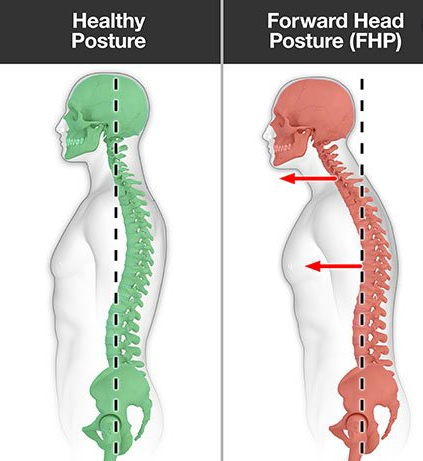

If you’ve been told your back pain is “probably just posture,” it can feel like a bit of a brush-off, vague advice to “sit up straight” that doesn’t actually explain anything or fix anything.
But posture genuinely is one of the most common drivers of chronic lower back pain, and understanding exactly how it causes pain is the first step to actually correcting it, rather than just being told to try harder.
The good news is that postural back pain is also one of the more predictable and correctable patterns we see, once you understand what’s actually driving it, the path forward is usually clear.
 How Bad Posture Actually Causes Back Pain
 How Bad Posture Actually Causes Back Pain
Posture isn’t really about willpower, it’s about muscle balance. When you spend years in a particular position (hunched over a desk, slouched on a couch, looking down at a phone), certain muscles get used constantly while their opposing muscles barely get used at all.
A common example: prolonged sitting shortens and tightens the hip flexors and chest muscles, while the muscles that should be holding your upper back and glutes in a strong position become long, weak, and underused. Over time, this muscle imbalance pulls your spine and pelvis out of their natural alignment and that misalignment places uneven, sustained load on the joints and discs in your lower back.
This is why two people can sit at a desk for the same number of hours and end up with completely different outcomes. It’s not just the position itself, but how well your body’s supporting muscles are able to compensate for it, and that compensation ability changes with age, activity level, and how the imbalance has developed over time.
This is the same pattern we cover in The Real Cause of Lower Back Pain That Keeps Coming Back — postural imbalance rarely causes pain on day one. It builds slowly, until the tissue simply can’t compensate anymore.
Signs Your Back Pain Is Posture-Related
Postural back pain has a few recognisable patterns. It’s worth paying attention to whether any of these sound familiar:
It builds through the day, rather than starting sharply. Pain that’s mild in the morning and worse by evening, especially after long periods of sitting or standing in the same position, points toward a postural cause.
Changing position brings quick relief. If standing up, stretching, or moving around noticeably eases the pain within a minute or two, that’s a strong postural signal.
It’s accompanied by visible postural signs. Rounded shoulders, a forward head position, or one shoulder or hip visibly sitting higher than the other often go hand in hand with postural back pain.
It’s worse on desk-heavy or high-screen-time days. A clear pattern between long stretches at a computer or on a phone and flare-ups is one of the more reliable indicators.
It tends to sit in the same one or two spots. Postural pain is often localised, the same point in your lower back or between your shoulder blades, rather than moving around or radiating unpredictably.
None of these alone confirm a postural cause with certainty — that’s what a proper assessment is for, but if several of them sound familiar, posture is very likely playing a role.
Sound familiar?
A postural assessment shows exactly which muscle imbalances are behind your pain, so your exercises target the real problem, not a generic list.
Step-by-Step — How Posture Correction Works
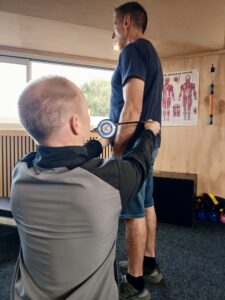 Fixing posture-related pain isn’t about reminding yourself to sit up straight more often — the underlying muscle imbalance needs to actually change. That generally happens in three stages:
1. Assessment of postural imbalances
A proper assessment looks at how your spine, pelvis, and joints sit and move, at rest and under load, to identify exactly which muscles are tight and short versus long and weak. This is what tells us whether your specific pattern is, for example, excessive lumbar curvature, forward head posture, or a pelvic tilt, rather than treating “bad posture” as one generic problem.
Two people can both have “bad posture” and need almost opposite corrective work, depending on which muscles are compensating for which.
2. Targeted corrective exercises
Once the specific imbalance is identified, the exercise programme targets it directly lengthening and releasing the muscles that have become tight, and activating and strengthening the ones that have become weak and underused.
This is different from generic “core strengthening” advice, because it’s built around your specific pattern rather than a one-size-fits-all list of exercises that may do little for your particular imbalance, or in some cases reinforce it further.
3. Ergonomic and habit changes
Exercise alone can be undone by spending eight hours a day back in the position that caused the problem. Adjusting your desk setup, how you sit, and building in regular movement breaks throughout the day supports the corrective work rather than working against it.
Small, consistent changes, monitor height, how often you stand up, where your phone sits when you’re using it — tend to matter more over months than any single dramatic fix
How Long Does Posture Correction Take?
 There’s no single timeline that fits everyone, it depends on how long the imbalance has been building and how consistently the corrective programme is followed. That said, most people notice some initial improvement in comfort within the first few weeks, once the most significant imbalances start to shift.
Lasting postural change, the kind that actually prevents the pain from returning, rather than just easing it temporarily, typically takes longer, often several months of consistent work.
Posture that’s taken years to develop doesn’t reverse in a week, but the trajectory usually becomes noticeable well before full correction is complete. It’s also worth setting realistic expectations early: the goal isn’t a permanently “perfect” posture, but a body that’s strong and balanced enough to move through daily life without the imbalance building back up.
Can Poor Posture Cause Hip Pain Too?

Yes — posture rarely affects just one area in isolation. The same muscle imbalances that pull on your lower back (tight hip flexors, weak glutes) sit directly around the hip joint too, so postural dysfunction commonly shows up as hip pain, tightness, or a sense of instability alongside back pain, not instead of it.
This is one of the reasons treating the back in isolation often falls short — if the hips and pelvis are still pulling out of alignment, the lower back keeps absorbing the extra load regardless of how much attention it gets on its own.
If your pain travels into your hip or down your leg specifically, it’s worth reading our guide on sciatica and back pain, since postural imbalance is also one of the more common contributors to sciatic-type symptoms.
Think posture might be behind your pain? A proper postural assessment will confirm exactly which imbalances are driving it — book yours today.
Sound familiar?
A postural assessment shows exactly which muscle imbalances are behind your pain, so your exercises target the real problem, not a generic list.